
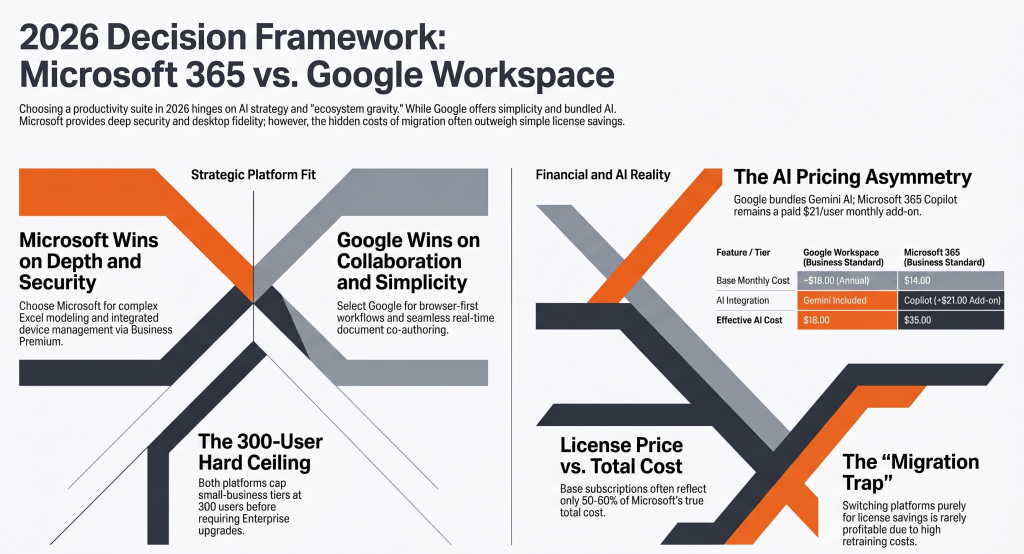
Microsoft 365 vs Google Workspace: A 2026 Decision Framework for SMBs
Choosing between Microsoft 365 and Google Workspace is no longer a simple email-and-documents comparison. In 2026, the decision hinges on AI bundling, security depth, migration cost, and how your team actually works. Both platforms raised prices in the last 18 months, both now embed AI into core plans (though on very different commercial terms), and both cap their small-business tiers at 300 users.
This framework gives SMB decision-makers and IT professionals in the US, UK, Australia, and Europe a structured way to decide. No platform loyalty. Just the criteria that determine total cost, operational fit, and switching risk.
The 2026 Pricing Reality
Headline license prices favor Google on paper, but the AI story reverses the math.
Google Workspace bundles Gemini AI into every Business plan at no extra charge. Business Starter runs about $8 per user per month, Business Standard $18, and Business Plus $28 on annual billing direct from Google, with every tier including Gmail, Drive, Docs, Sheets, Slides, Meet, Calendar, and Gemini AI. Annual commitment saves roughly 16 to 17 percent over monthly billing.
Microsoft 365 raised list prices across most commercial plans on July 1, 2026. Microsoft 365 Business Standard moved from $12.50 to $14.00 per user per month, Office 365 E3 from $23 to $26, and Microsoft 365 E3 from $36 to $39. Critically, Business Premium and Office 365 E1 held flat, making Business Premium one of the strongest value plays in the Microsoft portfolio.
The AI asymmetry is the decisive number. Microsoft Copilot is a paid add-on, not bundled. Microsoft 365 Copilot for Business lists at a promotional $18 per user per month, with a standard price of $21. Add that to a Business Standard seat and your effective cost jumps well past Google’s AI-inclusive Standard tier.
For non-US buyers, both vendors apply local currency adjustments, so UK, EU, and Australian list prices will differ from USD figures and can shift with exchange-rate normalization. Always price in your billing currency.
Where Each Platform Wins
Microsoft 365 Wins When You Need Depth
Microsoft is the stronger choice when your business depends on:
- Desktop Office fidelity. Complex Excel models, PowerPoint decks, and Word documents with heavy formatting render and edit more reliably in native desktop apps.
- Integrated security and device management. Business Premium bundles Intune, Defender for Business, Conditional Access, and device compliance. The July 2026 update pushed Defender for Office 365 Plan 1 into E3 and Business Premium, narrowing the security gap that previously justified E5 upgrades.
- Regulated industries. Finance, healthcare, and legal teams benefit from advanced eDiscovery, Insider Risk Management, and Communication Compliance in higher tiers.
- Unified stack consolidation. Teams, SharePoint, Exchange, and Intune under one vendor reduces integration overhead.
Google Workspace Wins When You Prioritize Simplicity
Google is the stronger choice when your business values:
- Real-time collaboration by default. Docs, Sheets, and Slides were built cloud-native. Simultaneous editing is smoother with fewer version conflicts.
- AI without a surcharge. Gemini is included, which matters for cost-conscious teams that want AI drafting and summarization without a separate per-seat purchase.
- Browser-first, device-agnostic work. Teams running Chromebooks, mixed hardware, or heavy mobile workflows face less friction.
- Administrative simplicity. A single Admin Console with fewer tiers and add-ons reduces the licensing complexity that Microsoft’s SKU matrix imposes.
The Migration Cost Nobody Budgets For
License price differences are usually dwarfed by switching cost. This is the most under-weighted factor in platform decisions.
If your organization is already deep in Teams, SharePoint, Exchange, and Intune, the migration effort (data transfer, retraining, workflow rebuilds, integration reconfiguration) typically exceeds the cumulative license savings over a three-year horizon. Industry practitioners consistently warn that switching purely to chase a lower sticker price is a losing move for integrated SMBs.
Switch platforms only when you have a strategic reason beyond price: standardizing after a merger, a genuine workflow mismatch, or a deliberate move to a browser-first operating model. Cost parity alone does not justify the disruption.
The Decision Framework
Work through these five criteria in order. Each maps to a concrete question.
1. Current Ecosystem Gravity
Where does your team already live? If staff rely on desktop Excel macros, Access databases, or Windows-managed devices, Microsoft’s gravity is strong. If they work in browsers and shared documents all day, Google fits.
2. AI Strategy and Budget
Decide your AI posture before comparing base prices. If you want AI capability across the whole team, Google’s bundled Gemini is cheaper per seat. If only a subset needs AI, Microsoft’s per-user Copilot add-on lets you license selectively rather than paying for AI on every seat.
3. Security and Compliance Requirements
Map your regulatory obligations (GDPR for EU and UK operations, HIPAA for US healthcare, industry-specific frameworks in Australia) to each platform’s included controls. Microsoft Business Premium delivers more built-in security depth at its price point. Google’s advanced compliance controls sit mostly in Enterprise tiers.
4. Organization Size and Growth Trajectory
Both platforms cap Business tiers at 300 users. Microsoft’s 300-user Business ceiling forces all Business-plan users onto Enterprise pricing simultaneously once crossed, creating a steep overnight cost jump. Google applies the same 300-user combined cap across Starter, Standard, and Plus. If you expect to cross 300 seats within your contract term, model Enterprise pricing now.
5. Total Cost of Ownership, Not List Price
Base subscription is only part of the spend. For Microsoft, the base price often represents only 50 to 60 percent of real cost once Teams Phone, meeting-room licensing, compliance tools, and Copilot are added. For Google, factor add-ons such as Google Voice, which starts around $10 per user per month and is not included in any base plan. Build a three-year TCO model including migration, training, and add-ons before deciding.
Common Mistakes to Avoid
- Comparing base prices without AI parity. Microsoft looks cheaper until Copilot is added to match Google’s included Gemini. Compare like-for-like feature sets.
- Ignoring renewal timing. Microsoft customers renewing between now and late 2026 can often lock current pricing by renewing early. Audit your renewal date before the increase compounds.
- Carrying dead licenses. Both platforms bill for inactive seats. Pull an admin usage report and eliminate unused licenses before any renewal or migration. This alone can cut 5 to 15 percent of spend.
- Switching to dodge a price increase. For integrated Microsoft shops, migration cost almost always exceeds the price delta. Decide on operational grounds, not sticker shock.
Real-World Use Cases
A 40-person UK marketing agency running Chromebooks, heavy on shared documents and client collaboration, with no legacy Office dependencies: Google Workspace Business Standard. AI included, minimal migration friction, browser-native workflows.
A 120-person US financial services firm with Windows fleet management, compliance requirements, and Teams-based operations: Microsoft 365 Business Premium. Included Intune, Defender, and Conditional Access carry the compliance load without E5 pricing.
A 25-person Australian consultancy already on Google, considering a move for Copilot: stay on Google. The migration cost and retraining outweigh the marginal AI benefit when Gemini already covers routine drafting and summarization.
Conclusion
The Microsoft 365 vs Google Workspace decision in 2026 is not won on list price. Google wins on AI-inclusive simplicity and browser-native collaboration. Microsoft wins on security depth, desktop fidelity, and ecosystem consolidation, with Business Premium standing out as its best-value tier after holding flat through the July 2026 increase.
Run the five-criterion framework against your actual environment, not an aspirational one. Model three-year total cost including AI, add-ons, and migration. Then let ecosystem gravity and switching cost, not headline pricing, make the final call. The worst decision is switching platforms to save on licenses only to spend more on migration than you ever recover.
Your practical takeaway: audit your current usage and renewal date first, price both platforms in your local currency with AI parity built in, and change platforms only when strategy (not price) demands it.
#Microsoft365 #GoogleWorkspace #SMB #ITStrategy #DigitalTransformation #CloudProductivity #M365 #WorkspaceVsM365 #ITDecisionMakers #BusinessTechnology #CloudMigration #Copilot #GeminiAI #TechProcurement #SmallBusinessIT #ITConsulting #ProductivitySuite #TCO #EnterpriseIT #RemoteWork